"Repetition does not transform a lie into a truth"
Franklin D. Roosevelt
Blending anti-Western and anti-French narratives with overt Kremlin propaganda, the extremist discourse of Burkina Faso’s president is attracting a wide audience across Africa and beyond
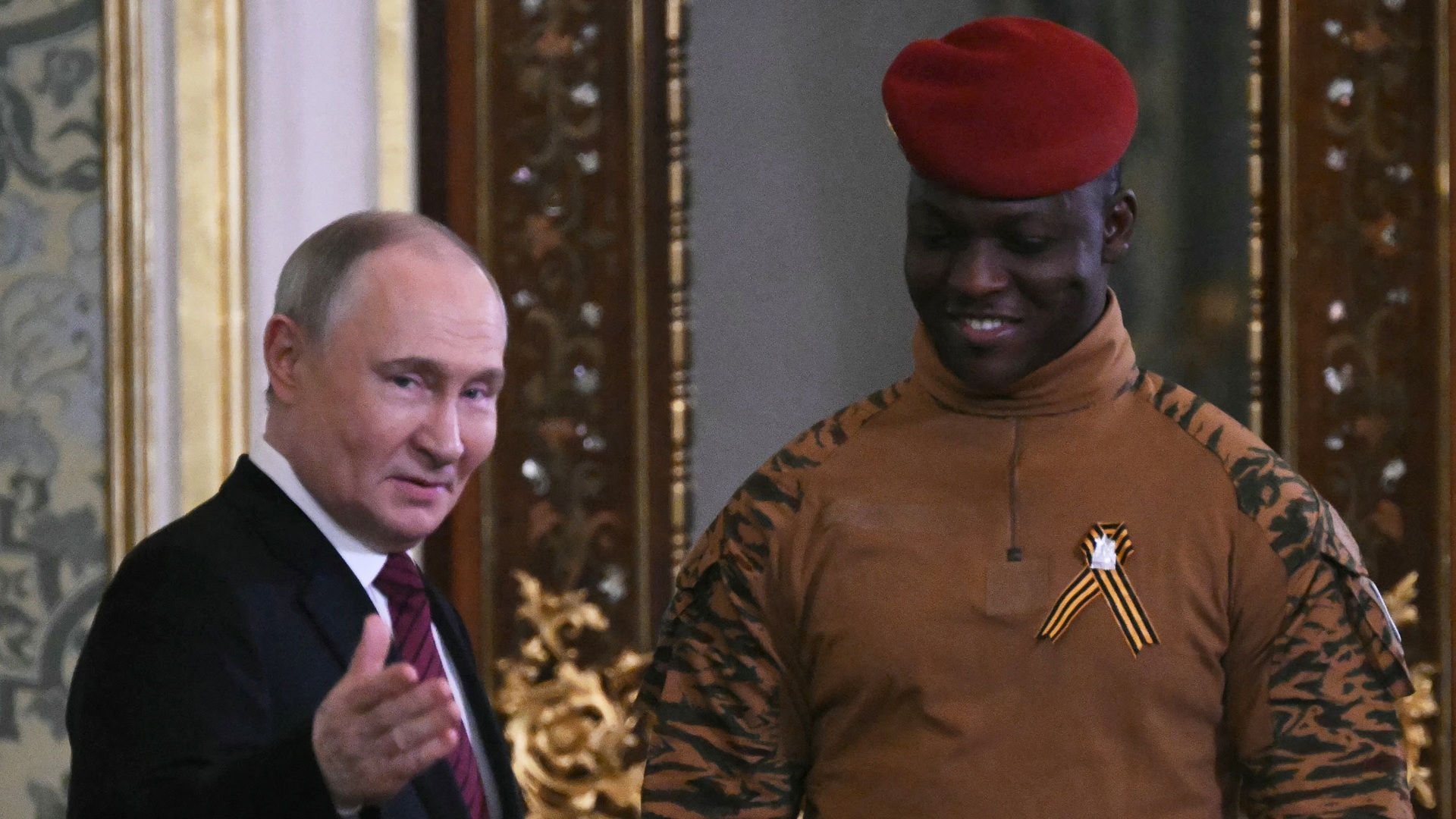
A recent report by Human Rights Watch accuses Burkina Faso’s armed forces of multiple abuses, particularly against the Fulani, an ethnic group regularly accused of supporting jihadists across West Africa. But President Ibrahim Traoré has a ready-made conspiracy-peddling explanation: a false-flag attack. “That’s what you call perfidy,” he says. “Terrorists come, they carry out massacres in certain places, often wearing our uniforms. Even if we’re told it’s the army […], it’s not us. They use our flags, all our insignia, and then they come and do this.”
His somewhat baby-faced appearance first became widely known on September 30, 2022, perched smiling atop an armored vehicle to the cheers of the crowd in Ouagadougou. That day, Captain Traoré led the second military coup of 2022 in Burkina Faso’s capital, ostensibly to restore security in the “land of upright men,” plagued by a jihadist insurgency that has ravaged the Sahel for more than a decade. Elevated to the presidency at just 34 years old, the youngest head of state in the world, he promised a swift return to civilian rule: “We are not here for power. In four, five, six months, order will be restored.”
Three years later, jihadist attacks have multiplied, and the man nicknamed “IB” is now firmly entrenched at the head of a military junta that has brought Burkina Faso into line. The once modest captain has grown in confidence and, in increasingly grandiloquent speeches, now presents himself as the leader of a “progressive and popular revolution.” The most charismatic leader of the Alliance of Sahel States, a Russia-leaning regional bloc formed in the summer of 2023 by the military juntas in Mali, Niger and Burkina Faso—Traoré never sheds his uniform, permanently wearing his pistol at his belt and combat gloves, as if ready to head to the front at any moment.
Threatened by terrorist expansion, the apprentice dictator spares no blows against another designated enemy: the West, with France as its supposed spearhead.
In July 2023, ten months after seizing power, Ibrahim Traoré shook the Russia–Africa summit in Saint Petersburg with a blistering speech against “imperialists [who] pull the strings.” The intervention struck a chord with part of the continent’s youth. Energized, the captain has since consistently donned the mantle of defender of African sovereignty, accompanied by virulent rhetoric against the “imperialists”—in other words, the West. His primary target: France and its “ungrateful” President Emmanuel Macron, at whom he repeatedly takes aim. During a visit to Moscow in May 2025, Traoré denounced on the Kremlin’s network Russia Today a France that continues “to see Africans as subhuman.”
“You can’t take away from Traoré a certain form of courage. He clearly owns his positions, his constant stance against the West, and that resonates in Africa,” says Benjamin Roger, a journalist with Le Monde and a specialist on the continent. “He has a knack for punchlines, he’s young and willingly puts himself forward. It’s hard to measure precisely, but I think he enjoys a positive image among part of the youth in Africa.”
Today, IB’s portrait is displayed throughout the streets of Ouagadougou—even on national football team jerseys sold in markets—and his “vision” is praised in every appearance on camera. A genuine personality cult has taken hold in Burkina Faso, embodied by the unwavering support of the Wayignans, the “citizen watch,” whose members mobilize by the hundreds whenever the captain needs defending, sometimes carrying Russian flags.
Everywhere, IB asserts that corruption has been eradicated and that all economic indicators are in the green. On Russian television, he promises that his irrigation reforms will allow the country to produce “at least two or three times a year.” While more than 40% of Burkina Faso’s population faced food insecurity in 2022, Traoré declared in his 2026 New Year’s address that the country had “achieved food self-sufficiency during 2025.” He has launched a highly publicized policy of industrialization and major public works, overseen by officers in fatigues, whose spectacular ambitions evoke the figures of a Stalinist Gosplan. Plans have been announced, for example, to build 3,000 to 5,000 kilometers of roads per year, when Burkina Faso has paved just 4,000 kilometers in 65 years.
“The whole world is watching Burkina Faso, Africans are watching Burkina Faso, which has drawn a model,” IB declared in his national day address. “This struggle we are waging is not only for Burkina Faso, it is for all Black peoples.” According to figures from the International Monetary Fund, however, the country’s growth rate has not significantly changed since he came to power. Still, this assertive rhetoric, which stands out on the continent, appears to generate immense enthusiasm among part of Africa’s youth and the Afro-descendant diaspora.
It is online that this popularity finds its strongest echo, where a propaganda campaign of perhaps unprecedented scale on the continent is unfolding. Myriad accounts—whose authenticity is often questionable—share videos that sometimes rack up tens of millions of views, praising Ibrahim Traoré and denouncing the West. A significant share of this content consists of AI-generated deepfakes, going so far as to depict Beyoncé, Justin Bieber, Rihanna or Maître Gims singing Traoré’s praises.
“I sometimes see videos of myself speaking Spanish or Chinese. I thank those who do it, because they manage to translate my speeches, but it’s very dangerous,” the young leader feigned concern in June 2024. While Russia is often pointed to, much of the disinformation appears in fact to be orchestrated directly from Burkina Faso, notably within his close circle. Its success is global, and the Burkinabè president’s fame has far exceeded the borders of francophone West Africa: popular English-speaking YouTubers, a France far-left LFI (France Unbowed) municipal candidate, an AJ+ commentator, reggae artists, and even boxing superstar Anthony Joshua now praise him.
“Democracy is not for us,” Ibrahim Traoré declared in an interview with the press on April 2. In practice, beyond muzzling the opposition and civil society, dissolving political parties, criminalizing “homosexual practices,” and reinstating the death penalty, the junta he leads has brought national media into line, now saturated with hard-hitting reports glorifying the armed forces.
“The Burkinabè press used to be one of the best and most independent in the sub-region,” explains Benjamin Roger. “But today there is nothing left, no dissenting voice. No one dares to speak or relay information anymore; he has created a real information bubble.”
French and Western media, which Traoré—in classic populist extremist terms redolent of both Vladimir Putin and Donald Trump—labels “lying media,” have been banned altogether: “They invent big lies to divide peoples,” the captain justified to Sputnik in May 2025, while praising media directly controlled by the Kremlin “for raising awareness.”
IB openly embraces his closeness to the Russian President, whom he has visited at least twice in Moscow. A “fraternal” relationship, in his words. Claiming that Russia and Burkina Faso share a “common struggle” for a “multipolar world,” Traoré adopts Moscow’s narrative on the war in Ukraine almost word for word. An invasion with very real imperial overtones, which the Burkinabè leader prefers to describe as a “special operation” and a “denazification effort,” lamenting the “Russophobia” of Ukrainians allegedly “manipulated” by the West: “They still haven’t understood that this whole maneuver was meant to collapse them and seize their critical minerals,” he argued on Sputnik.
Like other Alliance of Sahel States leaders, IB also accuses Ukraine of supporting terrorists in the Sahel.
Is this to obscure his own failures? While Ibrahim Traoré regularly announces crushing victories and continues to insist that “the war will end very quickly,” the Burkinabè army is struggling to contain the advance of jihadists. According to Reuters, JNIM—the most active terrorist group—carried out nearly 500 attacks in Burkina Faso in 2025 alone, making it one of the countries most affected by terrorism in the world. Over a decade, jihadist violence in Burkina Faso has killed more than 26,000 people and displaced two million.
While official figures are scarcely communicated by the regime, IB claimed in early April 2026 that this number had fallen to “well under one million” and promised that there would be almost no displaced people by the summer.
Ibrahim Traoré never uses the term “jihadists” to describe those spreading terror in the Sahel, as if they were a different enemy altogether. “It’s not terrorism, in fact—it’s imperialism,” he said in May 2025. “Their objective is to keep us in a permanent war so that we cannot develop and they can continue looting our resources.”
Speech after speech, the captain-president speaks of a “maintained war” and accuses France and the West of arming and financing Islamist armed groups. This false narrative has been promoted for several years by leading figures of the “pan-Africanist” movement, such as Kemi Seba and Nathalie Yamb.
In early January, Burkina Faso’s security minister announced that “an attempt to destabilize the country” had been thwarted, including a plan to assassinate Captain Traoré. “A large part of the funding comes from Côte d’Ivoire,” he added. On national television, it was claimed that France was also involved—and even that Macron had launched “a plan to eliminate ‘undesirable’ leaders in Africa.” The source? Russia Today...
Since IB took power, this is at least the sixth such announcement, often following a similar script: authorities thwarted rogue soldiers, allegedly directed from Abidjan—seen as a hub of “Françafrique”—with the complicity of “Western intelligence services” or even jihadists. Dozens of Burkinabè military officials have been arrested in a matter of months on charges of plotting.
“There really were people who tried to overthrow IB, which partly explains the arrival of the Russians,” says Benjamin Roger. “But there have also been coup plots exaggerated by the regime to say ‘they’re plotting against us.’ Traoré has carried out such a purge in both the army and civil society that today everything is tightly locked down.”
In September 2025, IB accused Côte d’Ivoire of having concluded a “non-aggression pact” with jihadists. Three months later, at the Alliance of Sahel States summit in Bamako, in a florid indictment of internal enemies with “shrew-like faces” and “imperialists” who “do everything to set West Africa ablaze,” he drew a parallel with the 2011 Arab Spring, implying it had been orchestrated by those same “imperialists.”
IB’s repeated outbursts have won over part of the global conspiracy ecosystem, which, after Muammar Gaddafi, Bashar al-Assad, Trump or Putin, has found a new strongman to champion.
As early as August 2023, Xavier Moreau—a former French soldier turned pro-Kremlin propagandist—said he was “extremely impressed by the transitional president of Burkina Faso,” calling him a “serious” man and a true example “of dignity, pride [and] solidity.” The following month, the enigmatic Franck Pengam, founder of French conspiracy media Géopolitique Profonde, described him as the “new hero of the multipolar world.”
Ultra-conspiratorial Twitter account Black Bond PTV, followed by nearly 100,000 people, has published dozens of tweets glorifying Traoré as he battles the “Deep State,” while star French conspiracy influencer Idriss Aberkane has enthusiastically relayed the regime’s unverifiable figures.
In April 2025, the conspiracy mongering antisemitic French comedian Dieudonné posted a video of “unconditional support” for Ibrahim Traoré, whom he called a “new hero” who “restores hope”: “I stand, of course, with Captain Traoré […] just as I stood with Colonel Gaddafi in his bunker.”
The conspiracy-friendly pan-African channel Afrique Media and several influential pan-Africanist activists on social media regularly praise Ibrahim Traoré. Their leading figure, Kemi Seba, was received in Ouagadougou in June 2024 by the man he calls his “very dear brother.” In spring 2025, after yet another thwarted coup attempt was announced, Seba voiced total support for IB, while Swiss-Cameroonian activist Nathalie Yamb—sanctioned by the EU for pro-Kremlin propaganda—called for those responsible to be “executed in the public square.” The following month, she was awarded the Order of the Stallion, the country’s highest distinction. By late March 2026, she was even appointed to the board of the Institute of Black Peoples–Farafina, a “pan-African institution with scientific, ideological and cultural aims,” revived by the Burkinabè presidency.
Also prominent is Franklin Nyamsi, a widely followed Cameroonian academic obsessed with “Françafrique” conspiracies, sanctioned by France, where he resides, and a fervent supporter of Traoré. As is the flamboyant Egountchi Behanzin, who notably described Macron as a “puppet” of the peak French Jewish organisation CRIF in 2020. Identified as having acted as an influence agent for the Wagner group in Africa and also targeted by EU sanctions, Behanzin published an emotional open letter in November 2025 asking the captain-president for protection against the “persecutions” of “French imperialism.”
Beyond the francophone sphere, Moscow-based American disinformation merchant and conspiracist Jackson Hinkle praised Traoré’s “courageous leadership” in November 2024. Hinkle, a pro-Khamenei and pro-Hamas antisemitic influencer was speaking at a gathering of the “International Russophile Movement” in Johannesburg, and lauding his fight against “Al-Qaeda and other terrorist groups supported by the United States.” In October 2025, Hinkle made his own pilgrimage to Ouagadougou, proudly posing in front of a statue of Thomas Sankara wearing a T-shirt bearing Traoré’s image.
On social media, he celebrates IB’s supposed spectacular achievements and laments that the West has tried to kill him “at least sixteen times.” A theme echoed, for instance, by George Galloway, the pro-Iranian former British MP and former RT presenter, who said in April 2025 on his own talk show that “France and the United States are clearly determined to kill him,” because he “actually governs in the interest of his own people, not the Empire.”
By Galloway’s own admission, his videos about the young captain are among his most successful on social media—suggesting that the Ibrahim Traoré phenomenon is unlikely to fade anytime soon.
For sixteen years, Conspiracy Watch has been diligently spreading awareness about the perils of conspiracy theories through real-time monitoring and insightful analyses. To keep our mission alive, we rely on the critical support of our readers.