
"Repetition does not transform a lie into a truth"
Franklin D. Roosevelt
A self-styled “anti-Zionist” faction is developing within the American right that is closely aligned with extremists, neo-Nazi influencers and conspiratorial narratives.
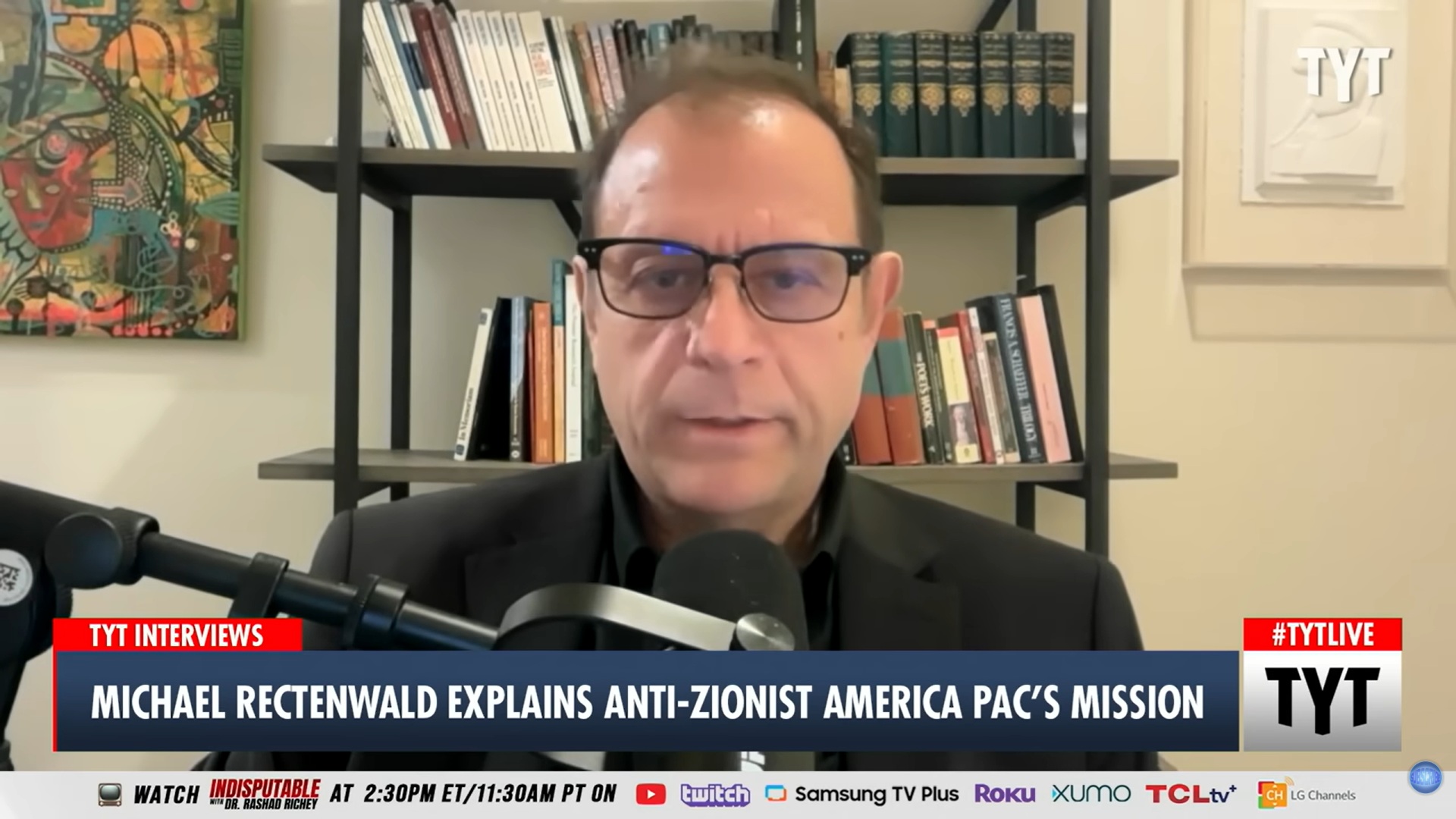
The Anti-Zionist America Political Action Committee (AZAPAC) emerged in the summer of 2025, founded by Michael Rectenwald. The former New York University professor, now active in libertarian circles, is close to the radical right. “We’re not like leftist anti-Zionists, calling for ‘from the river to the sea’ and all this nonsense,” he stated in an interview. “We are not trying to say the State of Israel should not exist. That is not our concern. Our concern is the U.S. government only, and what it’s doing.”
The group supports candidates across the political spectrum, based on their opposition to aid to Israel and refusal to accept funding from pro-Israel lobbying organizations. Yet behind this political stance, troubling ideological convergences emerge, combining anti-Zionism, conspiracism, and antisemitism.
From its inception, AZAPAC has sought to position itself within existing networks of influence, including among influential hate figures on the American far right. Rectenwald notably attempted to secure the support of Nick Fuentes, who monetises his openly antisemitic and Holocaust-denying positions.
He has also aligned himself with Dan Bilzerian, a hate influencer with tens of millions of followers who, since October 7, 2023, has become an increasingly shrill relay for blatantly antisemitic and conspiratorial narratives. Bilzerian has claimed that Jews or Israel are behind events such as 9/11, the assassination of JFK, the Epstein case, and COVID-19, while rehashing classic tropes about Jewish control of media and finance and making openly hostile statements, describing Judaism as “disgusting” and calling for people to “kill Israelis.”
These alliances are not incidental. They contribute to the circulation of a classic conspiracist imaginary, in which expressions such as “Jewish elites” or “Jewish mafia” are employed by Rectenwald himself. This rhetoric draws on well-established codes of contemporary antisemitism, where criticism of Israel shifts into the essentialization of Jews everywhere as a collective power.
AZAPAC has also supported candidates linked to supremacist milieus. This heterogeneous coalition strategy, presented as pragmatic, is reinforced by media exposure within radical spheres, notably through Rectenwald’s appearances on the show hosted by Stew Peters, a notorious antisemie and conspiracy theorist. Rectenwald says he does not “use the same language” as Peters, yet praises him for doing “excellent work exposing the Zionist network,” and acknowledges that a significant portion of AZAPAC’s early funding followed these appearances, during which the show also promoted the PAC.
Rectenwald projects an image of himself as a libertarian and situates his project within an “America First” logic, opposed to what he frames as “Israel First.”
He fits into a longstanding American isolationist tradition, backed by libertarian circles such as the Ron Paul Institute for Peace and Prosperity, founded by former congressman Ron Paul to promote a non-interventionist foreign policy, as well as institutions like the Mises Institute, a major hub of radical libertarian thought, where Rectenwald has published several articles.
However, this tradition has a more ambiguous history. In the United States, the revisionism movement emerged as a critique of official war narratives. Some of its proponents, however, after World War II gradually shifted toward Holocaust denial.
The case of Harry Elmer Barnes is central. In a 1966 article in the Rampart Journal (“Revisionism: A Key to Peace”), he repurposed the concept of revisionism to challenge established facts about World War II and the Holocaust.
His intellectual successor, James J. Martin, extended this trajectory. A libertarian historian, he published American Liberalism and World Politics, 1931–1941 (1964) with Devin-Adair, in which he criticized U.S. foreign policy and dominant wartime narratives. The publisher’s director, Devin Garrity, himself associated with several libertarian organizations, also took part in the first conference of the Institute for Historical Review (IHR), a key organization in the international dissemination of Holocaust denial. After Barnes’s death, Martin helped to spread these theses within libertarian circles.
Martin notably gave an interview to the libertarian magazine Reason in the 1970s, where he advanced forms of “soft” denialism, contributing to the circulation of such ideas in a space claiming to defend free speech and critique of power.
This role as a relay is not confined to the past: Reason, which helped popularize these positions, still holds visibility within contemporary libertarian ecosystems, where giants from the tech world gravitate, including X proprietor Elon Musk, purveyor of antisemitic and racist conspiracy theories including White Genocide and Great Replacement Elon Musk, contributing to a form of indirect legitimization.
Martin was also involved in the development of the IHR, highlighting the connections between certain segments of libertarianism and narratives that distort the history of the Holocaust. These trajectories illustrate how a critique of state power can evolve into an ideologically driven rejection of established historical facts.
Rectenwald’s discourse extends beyond foreign policy. It is rooted in a worldview deeply shaped by conspiracism and antisemitism. On social media, he has promoted the idea that the September 11 attacks were orchestrated by a “Jewish mafia.”
This conspiracist obsession with so-called hidden global control by Jews also informs interpretations of contemporary events, including the October 7, 2023 Hamas terrorist attacks, where Israel and its allies are portrayed as manipulative or indirectly responsible, feeding a paranoid vision of international relations.
The use of visual metaphors, such as the “puppet master” controlling governments amplifies this rhetoric. While Rectenwald claims ignorance of the antisemitic dimension of such imagery, its repeated use contributes to the dissemination of deeply rooted stereotypes.
Thus, AZAPAC’s anti-Zionism is regularly shaped by reductive explanatory frameworks, in which complex geopolitical dynamics are reduced to the actions of a supposedly homogeneous and omnipotent group.
Despite its marginal character, AZAPAC is gaining increasing visibility. Rectenwald has nearly 100,000 followers on X, while figures surrounding the movement command much larger audiences. Bilzerian, for instance, has 29.6 million followers on Instagram and 2.1 million on X. Having recently announced his candidacy for the U.S. Congress, he is bringing these narratives from online spaces into the electoral arena.
Their objective is clear: to influence the November midterm elections by targeting candidates perceived as too supportive of Israel.
AZAPAC is also part of a broader effort to challenge the use of U.S. public funds to support Israel. This positioning may gain traction as international tensions persist.
Researchers and observers warn that associations with far-right figures and conspiracist narratives risk discrediting legitimate criticism of Israeli policy by fueling confusion between anti-Zionism and antisemitism. The growing profile of AZAPAC also reveals how, in certain contexts, the boundary between anti-Zionism, antisemitism, and conspiracism can become blurred.
This dynamic is not confined to the United States. In Poland, far-right politician Konrad Berkowicz displayed an Israeli flag combined with a swastika in parliament on Holocaust Remembrance Day 2026, illustrating a form of trivialization of Nazism and the Holocaust.
Nor is the phenomenon limited to the far right: some forms of anti-Zionism on the far left have also been criticized for drifting toward conspiracist narratives or distortions of the Holocaust, notably through comparisons between Gaza and Auschwitz.
AZAPAC does not create a new phenomenon; rather, it makes visible an existing configuration in which anti-Zionism becomes a common language for actors with otherwise very different trajectories.
For sixteen years, Conspiracy Watch has been diligently spreading awareness about the perils of conspiracy theories through real-time monitoring and insightful analyses. To keep our mission alive, we rely on the critical support of our readers.