"Repetition does not transform a lie into a truth"
Franklin D. Roosevelt
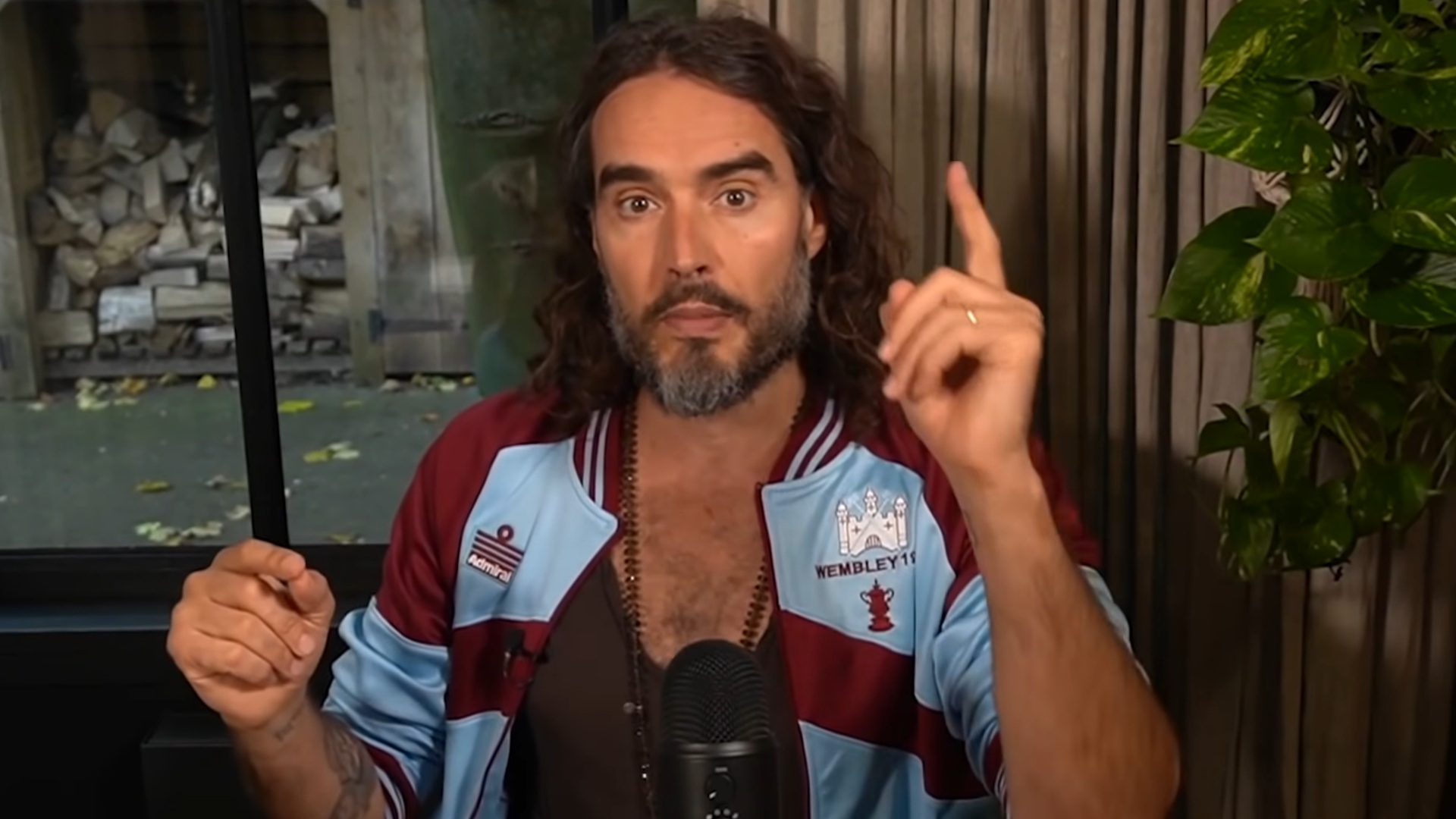
Russell Brand (1975–) is a British comedian, actor and former television presenter who became one of the English-speaking world's most prominent conspiracy influencers during the Covid-19 pandemic. Once a left-wing critic of capitalism and political elites, Brand underwent a remarkable political transformation, gravitating towards the far-right MAGA movement and some of its most extreme conspiracy theorists, while amplifying pro-Kremlin disinformation about Russia's war in Ukraine. In November 2026, he was convicted of rape and sexual assault and sentenced to ten and a half years in prison.
Known for his flamboyant personality, provocative humour and highly publicised celebrity scandals, Brand spent the past decade cultivating an enormous online following through conspiratorial claims and attacks on mainstream media, science and political institutions.
By 2026, he had amassed more than 10 million followers on X, nearly seven million YouTube subscribers, 4.8 million Instagram followers and two million followers on Rumble, the alternative video platform popular with the American conspiracist right.
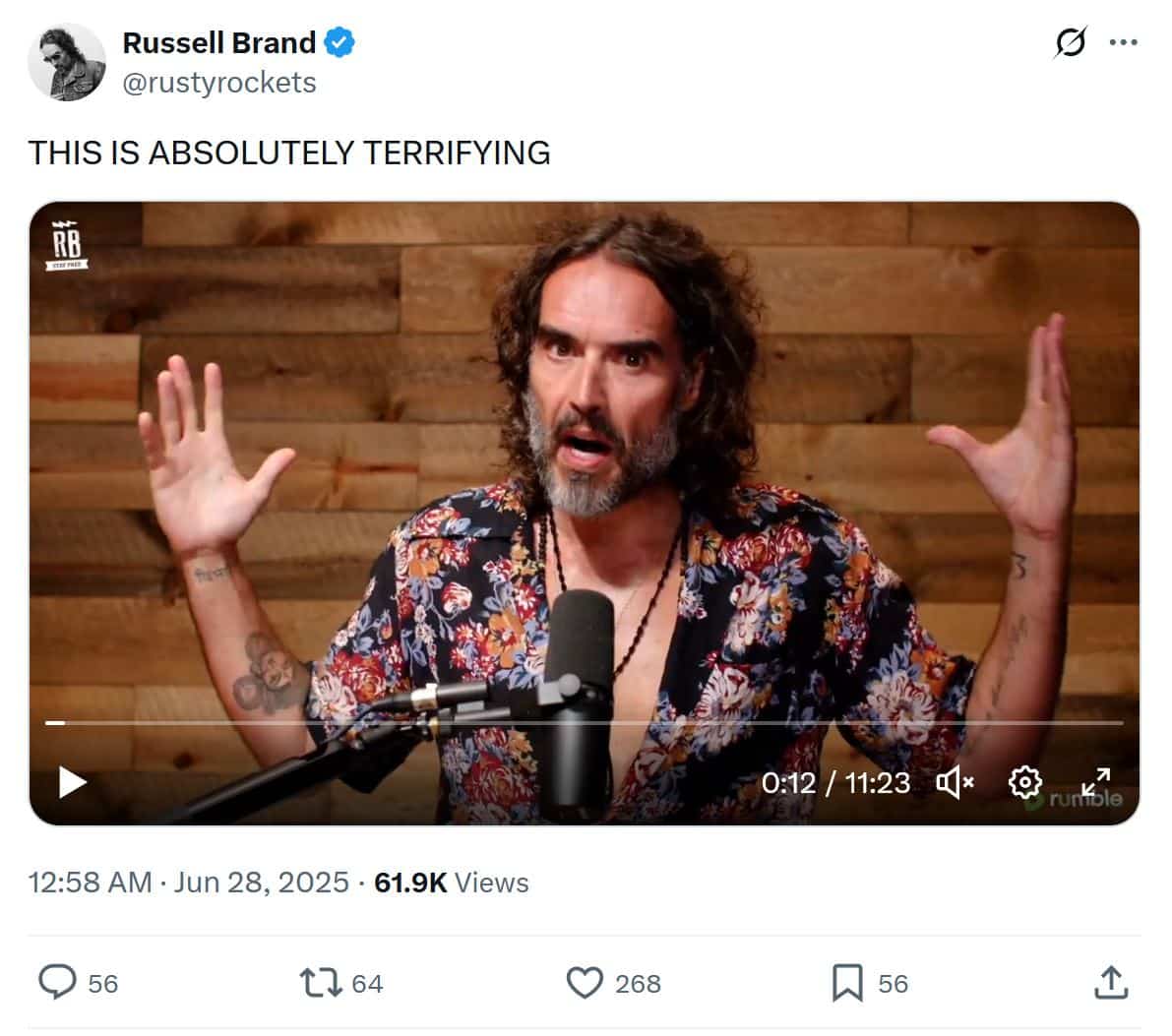
His online persona combines sensationalist headlines, direct appeals to his audience and a theatrical, often humorous delivery. His videos promise that viewers have been "LIED TO", that hidden secrets have been "EXPOSED", or that something previously dismissed as a conspiracy theory is, in fact, true. He affectionately addresses his followers as "my awakened wonders", reinforcing the notion that they belong to an enlightened minority capable of seeing through official deception.
Since his public conversion to Christianity in 2024, religious language has also become central to his broadcasts. Even after being charged with rape and sexual offences in April 2025, Brand continued promoting conspiracy narratives through his online programme Stay Free.
Brand began building his online political following in 2014 with The Trews: True News with Russell Brand, a YouTube series in which he commented on current affairs, criticised mainstream media and interacted directly with viewers.
His conspiratorial tendencies were already evident in episodes questioning childhood vaccination and portraying then-British prime minister David Cameron as a threat to children.
But the Covid-19 pandemic marked his emergence as a leading conspiracy influencer.
As lockdowns, vaccination campaigns and public health restrictions became the focus of global controversy, Brand increasingly portrayed governments, pharmaceutical companies and international organisations as participants in a vast project of social control.
His YouTube audience nearly doubled during 2021, reaching almost five million subscribers by the end of that year.
Covid-19, "Big Pharma", the "Great Reset", the war in Ukraine and the supposed "Deep State" became recurring themes.
Brand promoted claims that Covid-19 had been created in a laboratory, suggested that pandemic restrictions were designed to silence or control populations, and circulated alarming allegations about vaccine safety, including claims involving vaccine experiments on prisoners in Chinese concentration camps.
His approach frequently blurred the distinction between legitimate scrutiny of public health policy, unsubstantiated speculation and outright conspiracy theories.
One of his most successful narratives concerned the "Great Reset", an initiative launched by the World Economic Forum (WEF) in 2020 to promote economic and social reforms following the pandemic.
Conspiracy theorists recast the initiative as supposed evidence of a secret plan by global elites to abolish private property, impose authoritarian controls and strip ordinary citizens of their freedoms.
Brand enthusiastically amplified this interpretation.
Where his earlier pandemic videos typically attracted between 100,000 and 300,000 views, videos invoking the "Great Reset" began drawing audiences of more than a million.
In January 2022, his video WHAT?! The Great Reset Is NOT A Conspiracy Theory! attracted nearly three million views. Brand warned viewers that even as the pandemic receded, governments were supposedly advancing an economic programme under which citizens would own nothing and be happy about it.
In Brand's worldview, the WEF, founded by Klaus Schwab, became a central symbol of an unelected global elite allegedly directing world affairs.
His suspicion of government institutions extended to the US Defense Advanced Research Projects Agency (DARPA), the Pentagon's research and development agency established in 1958. In January 2025, Brand accused DARPA of seeking to manipulate human behaviour, framing military research as evidence of a broader programme of population control.
During the 2010s, Brand positioned himself as a radical critic of capitalism, inequality and the political establishment. He supported left-wing causes, interviewed Labour leader Ed Miliband ahead of Britain's 2015 general election and expressed sympathy for Jeremy Corbyn's political project.
But during the pandemic, his conspiratorial content drew him into the American right-wing media galaxy, where opposition to vaccination policies, hostility towards mainstream journalism and fears of globalist control had become central political themes.
Brand began engaging with figures such as podcasters Ben Shapiro, Joe Rogan, Tucker Carlson and future US Health Secretary and vaccine sceptic Robert F. Kennedy Jr., whose audiences often overlapped with the broader anti-vaccine and MAGA movements.
His political shift became unmistakable during the 2024 US presidential election. Brand publicly endorsed Donald Trump, appeared at the Republican National Convention and increasingly embraced the language and priorities of the American populist right.
In December 2024, he attended a gala at Trump's Mar-a-Lago resort organised by America's Future, a conservative organisation chaired by former Trump national security adviser Michael Flynn, one of the most prominent promoters of conspiracy narratives surrounding the 2020 presidential election.
Other attendees included Tucker Carlson, Roger Stone and Mel Gibson.
The former anti-capitalist celebrity had become a familiar figure in a political and media world populated by election deniers, promoters of QAnon-adjacent narratives and far-right conspiracy influencers.
Yet his underlying rhetoric remained remarkably consistent: ordinary people were being deceived and manipulated by powerful elites, and only independent voices such as his own could reveal the truth.
Brand's conspiratorial worldview also shaped his commentary on Russia's full-scale invasion of Ukraine.
He amplified the false allegation that the United States operated biological weapons laboratories in Ukraine, a narrative promoted by the Kremlin and subsequently circulated throughout the Western conspiracy ecosystem, including by QAnon supporters and Robert F. Kennedy Jr.
The allegation distorted the existence of legitimate US-supported biological threat-reduction programmes in Ukraine, presenting public health and laboratory safety cooperation as evidence of a clandestine biological warfare operation.
Brand's willingness to promote such claims placed him within a wider network of Western influencers who repeatedly amplified narratives favourable to Moscow.
His commentary on Ukraine also frequently focused on alleged Western manipulation, censorship and hidden interests behind the conflict, themes widely exploited by Russian state propaganda to undermine support for Kyiv.
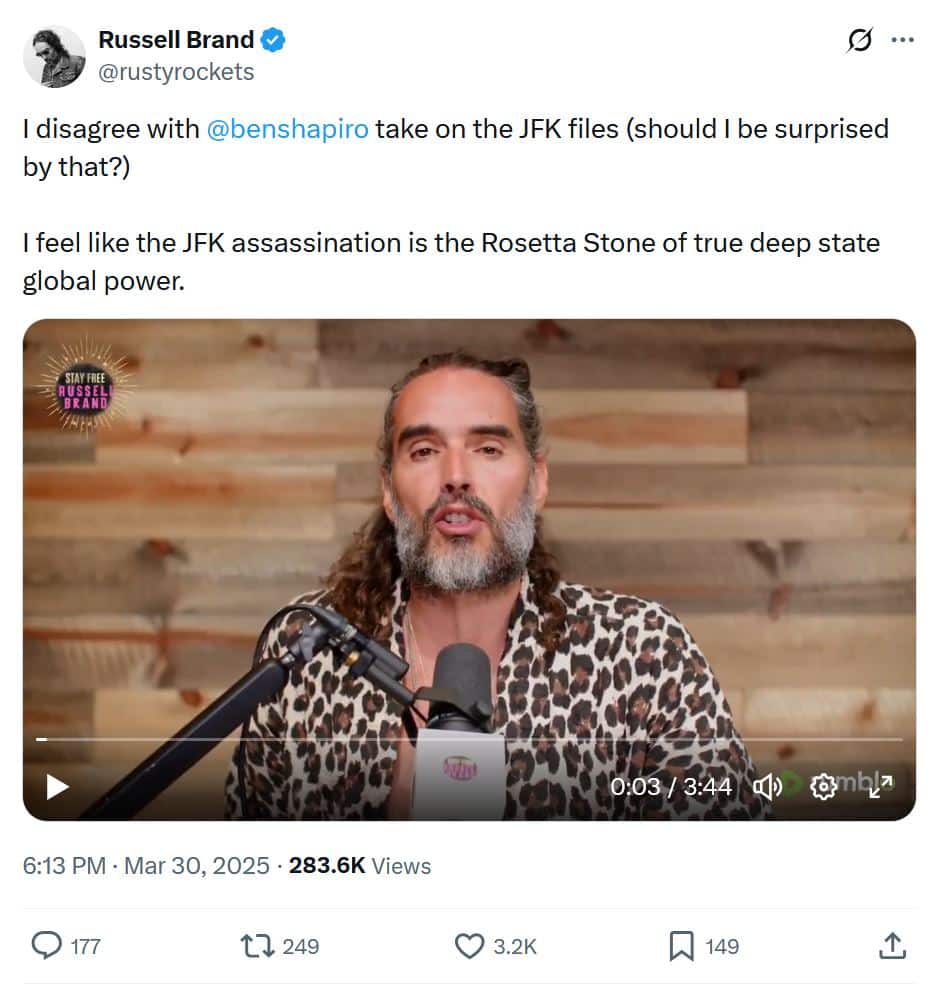
Another enduring obsession has been the so-called "Deep State", the supposed hidden network of intelligence officials, bureaucrats and political elites secretly controlling governments regardless of election results.
Brand has invoked this shadowy establishment to explain everything from allegedly rigged elections to the assassination of President John F. Kennedy.
He has also entertained claims surrounding the Clintons, including the discredited "Pizzagate" conspiracy theory, which falsely alleged that senior Democrats were involved in a child sex-trafficking operation centred on a Washington, DC, pizzeria.
The supposed mysterious deaths of people associated with Bill and Hillary Clinton have provided further material for his conspiratorial commentary.
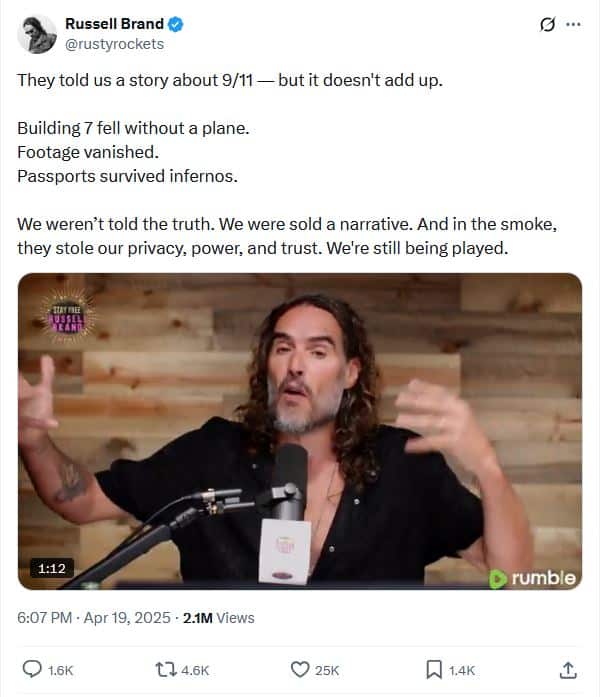
Even the September 11, 2001 terrorist attacks have featured in Brand's repertoire, with the comedian casting doubt on established accounts of the attacks.
Across these subjects, Brand has relied on a familiar formula: present an alarming allegation, question the official explanation and suggest that powerful institutions are concealing the truth.
Brand's journey from comedian to conspiracy guru has been accompanied by an increasingly overt spiritual mission.
He has organised spiritual retreats with his wife, promoted kundalini yoga and marketed supposedly protective amulets to followers concerned about the harmful effects of Wi-Fi and other electromagnetic signals.
His desire to serve as a spiritual guide is hardly new.
In 2013, Brand toured with a stand-up show entitled Messiah Complex, in which he satirised his own vanity and fascination with revolutionary and religious figures.
More than a decade later, the messianic imagery has become a conspicuous feature of his public identity.
With his trademark long hair, beard and open-necked shirts, Brand has appeared in promotional material holding bread and Christian symbols, inviting followers to join his weekly Break Bread discussions on Locals, a subscription-based platform associated with the conservative media world.
He presents these conversations as an opportunity to explore his Christian faith in greater depth.
His first guest was Tucker Carlson, the former Fox News host who has become one of the most influential personalities in the American conspiracist right.
Brand's public embrace of Christianity, including his baptism in 2024, coincided with his growing proximity to conservative American media personalities and audiences.
His new religious identity also reinforced a central theme of his conspiratorial messaging: that mainstream society had lost its moral bearings and that salvation lay outside established institutions.
Brand's embrace of conspiracism also proved commercially lucrative.
Research into his online activities has documented how increasingly sensationalist content attracted larger audiences, particularly as he embraced subjects associated with right-wing populism, Covid scepticism and alleged globalist conspiracies.
The more provocative the subject matter, the greater the potential for clicks, subscriptions and advertising revenue.
Before his demonetisation on YouTube, Brand reportedly earned substantial advertising income from his videos. His move towards Rumble and its associated subscription platform Locals allowed him to develop alternative revenue streams.
His Stay Free programme encouraged followers to subscribe to exclusive content, while sponsorships promoted products ranging from nutritional supplements and wellness treatments to gold investments and privacy-focused technology.
Some advertisers themselves operated within the wider market for alternative health products and distrust of conventional medical institutions.
Brand thus became part of a broader economy in which conspiracy narratives, personal branding and commercial products reinforce one another.
When YouTube suspended his advertising revenues following the publication of sexual assault allegations in September 2023, the decision became further ammunition for his claims of censorship and institutional persecution.
Rumble, meanwhile, refused to follow YouTube's example.
Perhaps the most revealing aspect of Brand's conspiratorial worldview is the way he has applied it to his own legal troubles.
In September 2023, The Sunday Times, The Times and Channel 4's Dispatches published the results of a joint investigation into allegations of rape, sexual assault and abusive behaviour involving several women.
Brand denied the allegations and immediately suggested that he was the victim of a coordinated campaign by mainstream media organisations seeking to silence him.
His response was amplified by prominent figures in the American and international conspiracist right.
Elon Musk publicly supported Brand, suggesting that established media organisations resented competition from independent voices.
Andrew Tate, the British-American influencer known for his misogynistic rhetoric and his own legal troubles, also rallied to Brand's defence.
Tucker Carlson suggested that the allegations might be connected to Brand's criticism of pharmaceutical companies and his commentary on the war in Ukraine.
In this interpretation, the allegations themselves became evidence of the conspiracy Brand had spent years warning his followers about.
Rather than treating the accusations solely as criminal allegations to be addressed through the courts, Brand and his supporters framed them as part of a wider campaign against dissenting voices.
His religious conversion provided an additional dimension to this defence, allowing him to contrast his former life of excess with his supposedly redeemed Christian identity.
On 5 November 2026, a London jury found Brand guilty of raping one woman and sexually assaulting three others in offences committed between 2004 and 2009, when he was at the height of his television and comedy career. Four days later, he was sentenced to ten years and six months in prison. The sentencing judge, Mr Justice Joel Bennathan, described Brand as a sexual predator whose celebrity had fostered a sense of entitlement and disregard for women's consent. Brand denied the charges and was acquitted of two other rape charges and one count of attempted indecent assault. British police have also confirmed that they are investigating further allegations.
Following his conviction, Brand continued to deny wrongdoing and encouraged his audience to question the legitimacy of the British justice system.
He argued that public confidence in the British government and legal institutions had collapsed, suggesting that the law had become a weapon deployed against individuals and institutions.
Referring to his behaviour before his religious conversion, he portrayed himself as a foolish young man who had subsequently found God. He urged followers to place their faith in God rather than in the surrounding culture and institutions he portrayed as hostile to him.
The same narrative that helped build his enormous online audience was now being deployed against the institutions holding him accountable: distrust the authorities, question the official account and believe that a hidden establishment is manipulating events.
For years, Brand encouraged his followers to believe that the truth was being suppressed by powerful institutions. Confronted with his own criminal conviction, he turned to that familiar script.
(Last updated: 13 November 2026)