
"Repetition does not transform a lie into a truth"
Franklin D. Roosevelt
Anyone wishing to understand the history of the Holocaust today has access to a wealth of knowledge that previous generations could scarcely have imagined. To claim historians have failed is to overlook this extraordinary collective achievement.
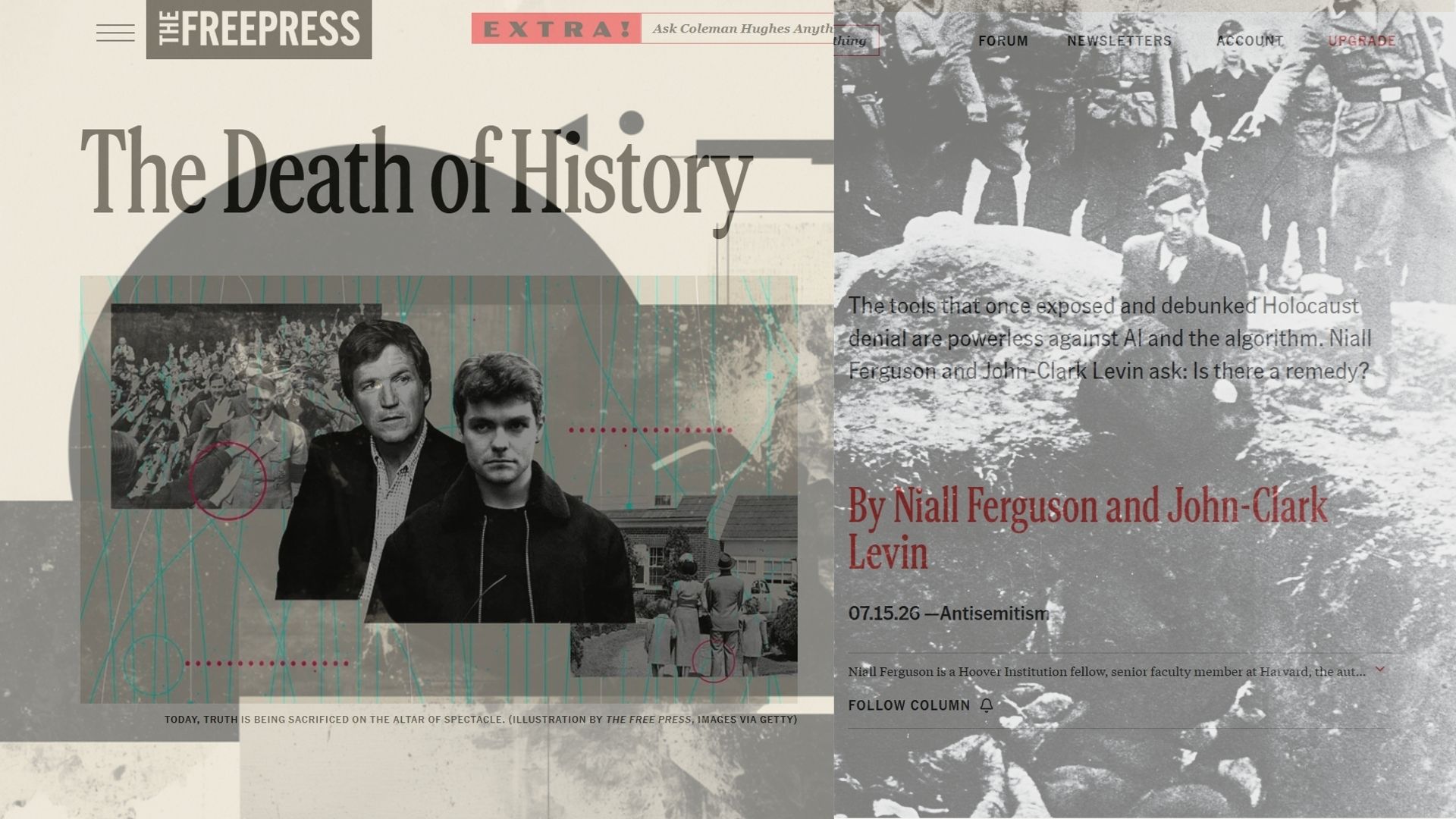
In a recent essay published in The Free Press, British historian Niall Ferguson and the AI researcher John-Clark Levin examine the reasons behind the resurgence of Holocaust denial in the age of social media and artificial intelligence. Their argument is deliberately provocative: historians have lost the battle. Although our knowledge of the Holocaust has never been greater, denial and antisemitic narratives continue to spread widely among younger generations through social media. According to them, the historian's traditional tools—archives, scholarly publications, footnotes, and rigorous historical argumentation—have become largely ineffective against the algorithmic logics that now shape the digital information environment.
This diagnosis deserves to be taken seriously. For several years, I too have observed this profound transformation of Holocaust denial. Social media, online influencers, short-form content, and now AI have fundamentally reshaped the ways in which hate narratives circulate. On this point, Ferguson rightly identifies a major historical shift. I disagree, however, with both his historical interpretation of Holocaust denial and his conclusion that historians have failed. My disagreement lies less with his diagnosis than with the historical interpretation he draws from it and the conclusions he reaches about historians' responsibility.
My first point of disagreement concerns his reading of the history of Holocaust denial. Ferguson portrays the period from the 1960s to the early 2000s as an era in which a handful of isolated cranks, confined to their basements, produced pseudo-historical pamphlets and books for a marginal audience. It is a compelling image, but a historically misleading one. For more than twenty years, my own research has focused precisely on the international organizations that promote Holocaust denial. Holocaust denial has never been merely the sum of isolated individuals. It has been structured around international organizations, publishing houses, journals, activist networks, conferences, financial support, and, from a very early stage, the Internet itself. It developed its own spaces of socialization, pursued a genuine publishing strategy, and at times even benefited from political backing, including state sponsorship, as illustrated by the Holocaust denial conference held in Tehran in 2006. For decades, it has constituted a transnational movement capable of continuously adapting its strategies of dissemination to technological and political change.
For the past eighty years, historians have not failed. On the contrary, they have built an unparalleled body of knowledge on the Holocaust. No genocide has ever been studied, documented, or taught so extensively. Thousands of books have been published in every major language, from the pioneering works of Léon Poliakov and Raul Hilberg to the most recent scholarship. German, Soviet, American, and Israeli archives have gradually been opened to researchers. The Nuremberg Trials, the Eichmann trial, the Frankfurt Auschwitz trials, the trials of Klaus Barbie and Maurice Papon, as well as the Irving v. Lipstadt trial, brought vast collections of documentary evidence into the public domain and systematically exposed the falsifications on which Holocaust denial is built.
Memorial institutions have also multiplied. Yad Vashem, the Mémorial de la Shoah in Paris, the United States Holocaust Memorial Museum, the memorials at Auschwitz-Birkenau and Majdanek, together with many other research centers, have become internationally recognized institutions. The Shoah Foundation has recorded more than 60,000 filmed testimonies from Holocaust survivors, providing future generations with an unparalleled historical resource. Educational programs have expanded across the world; thousands of teachers receive specialized training each year; study tours, exhibitions, digital resources, and online archives have never been more numerous. Anyone wishing to understand the history of the Holocaust today has access to a wealth of knowledge that previous generations could scarcely have imagined.
To claim that historians have failed is to overlook this extraordinary collective achievement. As my doctoral supervisor, the late Pierre Vidal-Naquet, often reminded us, "An astronomer does not answer an astrologer." The task of historians has never been to engage in daily debates with Holocaust deniers, but to establish the facts, write the history of the Holocaust according to the standards of historical scholarship, and transmit the results of research—not to respond to the provocations of those who sought to deny it. Far from failing, this collective endeavor has continued to deepen and refine our understanding of the Holocaust.
Would anyone ask the same question of scholars who study antisemitism? Does the dramatic resurgence of antisemitic hatred mean that their research has been in vain? Of course not. Researchers warn, analyze, and document. They do not determine public policy, regulate digital platforms, or control the algorithms that shape online discourse. Like many researchers, I too sometimes experience a sense of powerlessness when confronted with the speed at which these narratives spread today. But that feeling does not mean that historical scholarship has failed; it simply reminds us that knowledge alone is not always sufficient to transform the public sphere.
The widespread perception that Holocaust denial remained a marginal phenomenon for so long also reflects the fact that relatively few historians made denial itself an object of historical inquiry. Their primary task was to write the history of the Holocaust, and this necessary specialization sometimes led them to underestimate the organizational capacity, adaptability, and international reach of denial networks. Yet understanding these actors—their strategies, their transnational circulation, and their digital transformations—has now become an essential prerequisite for confronting them effectively.
The real transformation does not lie in the emergence of a new form of Holocaust denial, but in the evolution of its modes of dissemination. It is precisely on this point that I find Ferguson's analysis particularly compelling. The objectives of Holocaust denial have not changed; what has changed are the means by which they are pursued. The pseudo-scholarly conventions that once characterized denial literature have largely given way to the logic of the attention economy. For decades, Holocaust deniers sought to establish an appearance of academic credibility through extensive footnotes, archival references, and pseudo-scientific arguments. Today, these same narratives are repackaged, simplified, and amplified by influencers from a range of radical political milieus, particularly the American far-right figures discussed by Ferguson, who rely on short-form videos, humor, memes, provocation, podcasts, and AI-generated content.
I have examined this evolution over the past several years in a number of articles published in Conspiracy Watch. It is especially visible among several of the American influencers highlighted by Ferguson. Since October 7, 2023, this dynamic has accelerated even further, fostering new convergences between segments of the far right, the far left, and radical anti-Zionist discourse.
It would nevertheless be a mistake to conclude that pseudo-scholarly Holocaust denial has disappeared. The two forms now coexist. The established denial organizations continue to publish books and maintain their websites. Their latest initiative is the publication of a Holocaust denial encyclopedia that brings together, in a single volume, the movement's principal texts and arguments accumulated over the past half-century. The work is now widely available through major online retail platforms. Today's influencers did not invent Holocaust denial. They recycle, simplify, and popularize arguments developed over decades by denial organizations, which continue to supply the ideological content circulating through these new channels of dissemination. The rupture, therefore, is not ideological but media-driven. Social media platforms have not replaced the historical organizations; they have simply provided them with a far more powerful means of distribution.
Specialists of Holocaust denial remain remarkably few, even as the organizations they study have acquired an unprecedented capacity for dissemination. Funding for research, digital monitoring, and the study of these new information ecosystems remains woefully inadequate. As Ferguson rightly observes, producers of hate now attract millions of views thanks to algorithmic amplification. I would add that historians, by contrast, remain largely invisible within this digital environment, where visibility is increasingly determined by algorithms rather than by the quality of scholarship.
It is in this respect that I believe Ferguson is right. We have entered a new phase in the history of Holocaust denial. AI, deepfakes, automated content generation, and the proliferation of bot farms present deeply troubling new challenges. The strategies developed to confront Holocaust denial in the 1980s are no longer sufficient in an environment where virality outweighs evidence and where a few seconds of video can have greater impact than a scholarly work of several hundred pages. Historians have overwhelmingly won the battle to establish the historical record; the challenge now is to ensure that this knowledge continues to circulate in a digital environment where algorithms reward emotion, simplification, and provocation. History has not lost the battle for knowledge. Rather, to borrow Ferguson's phrase, it now faces "a battle for attention."
Faced with this transformation, historians must not abandon their methods. They cannot, however, meet this challenge alone. Educators, digital platforms, policymakers, and researchers must also work together. As the philosopher Patrice Loraux argued, democratic societies rest upon shared consent to common truths. Holocaust denial has always sought to undermine that consent. Today, social media, algorithms, and AI provide it with unprecedented means of dissemination. Preserving that shared commitment to historical truth is therefore a collective responsibility.
For sixteen years, Conspiracy Watch has been diligently spreading awareness about the perils of conspiracy theories through real-time monitoring and insightful analyses. To keep our mission alive, we rely on the critical support of our readers.