"Repetition does not transform a lie into a truth"
Franklin D. Roosevelt
The use of the term as an overblown accusation has more to do with the ‘post-truth’ era than facts
The invention of imaginary plots on the one hand and the denial of reality on the other are two sides of the same coin. That is why historical negationism, insofar as it stems from a fundamentally conspiracist approach, has always been at the heart of our editorial concerns. Over more than fifteen years of research and analysis, Conspiracy Watch has shown that the fight against all forms of negationism is part of its DNA.
This commitment binds us intellectually and morally. It has led us to develop a dual scepticism — both toward the mystifying narratives that present as true what is not (rigged elections, the harmfulness of vaccination, Brigitte Macron’s sex change, etc.) and toward those that present as false what is true (climate change, the moon landing, the gas chambers…).
The charge of ‘genocide’ directed at the Zionist movement and then at the State of Israel appeared almost immediately after World War II. In 1948, the very year Israel was founded, Maurice Bardèche, one of the pioneers of negationism, accused the young Jewish state of “genociding” the Arabs of Palestine. The theme that Palestinians were victims of a ‘genocide’ was elevated to a kind of article of faith by the Soviet propaganda apparatus, which spread it through its political and ideological networks and into the rest of the far left in the 1950s, and with renewed vigor after the Six-Day War (1967) and again after the Sabra and Shatila massacre (1982).
The propagandistic use of this word against Israel — a refuge for many Holocaust survivors — is by no means new. As perverse as the inversion of accusation it conveys may be (Howard Jacobson speaks of this “sadistic triumphalism” that make Jews “the torturer and not the tortured” and tramples on their past), it should surprise no one. Since its foundation, the Jewish state has had implacable enemies who would not hesitate to wield such a symbolic weapon.
But following Israel’s response to the massacre of 7 October 2023, this accusation ceased to be widely dismissed as grotesque. It has now spilled far beyond militant circles and is normalizing at an unprecedented pace. As the online magazine K. put it, “the name of Israel is now associated with the word genocide, and this time on the side of the guilty.” Take France for example. With the exception of political parties Place publique, the PRG and Génération Écologie, virtually the entire left (LO, NPA, LFI, PCF, Les Écologistes, PS), media outlets from diverse horizons (Al-Jazeera, L’Humanité, Le Monde diplomatique, Blast, Mediapart), conspiracy sites and papers (Rivarol, Égalité & Réconciliation), international NGOs (Amnesty International, Human Rights Watch, Médecins Sans Frontières, Oxfam), scholars, intellectuals, actors, filmmakers, singers, jurists, an international inquiry commission mandated by the — highly controversial — UN Human Rights Council, and even Josep Borrell, the former High Representative of the EU for Foreign Affairs, consider that a genocide is underway in Gaza.
Given the incendiary statements by some Israeli commentators and officials on the nationalist extreme right who generally align with a supremacist current represented in the government of Benjamin Netanyahu government by the ministers Bezalel Smotrich and Itamar Ben-Gvir ( the Likud MP who called to “burn Gaza” and to “remove all the Arabs from Gaza [and the West Bank]”), it is not possible to dismiss the accusation out of hand as coming solely from Israel’s enemies.
Two Israeli left-wing organizations, B’Tselem and Breaking the Silence, as well as the +972 Magazine website, speak openly of ‘genocide’, without providing elements beyond already known facts to justify that stance. Israeli writer David Grossman also expressed himself on the matter in an interview published in early August in La Repubblica:
“I refused for years to use this term: ‘genocide.’ But now I can’t help using it, after what I’ve read in the papers, after the images I’ve seen, and after speaking with people who were there.”
Grossman has campaigned for peace for decades. He lost his son in combat nearly twenty years ago. He is neither a traitor to his country nor a Jew suddenly turned anti-Zionist. Placed in the same situation, would we refuse to use every lawful means available — and calling something ‘genocide’ can be one such means — to politically oppose a government we believe is dragging our country toward ruin?
Antisemitism, anti-Zionism and the hatred of Israel that now thrives in progressive milieus worldwide do not alone explain the inflationary use of the term. One objective reason for this shift lies in the sheer number of Gaza casualties which, despite disputes over precise figures, most observers agree is excessively high for a population in which almost half are minors.
Provided by Gaza’s Ministry of Health, controlled by Hamas, these figures (about 66,000 dead and 169,000 wounded to date) do not distinguish between civilians and combatants. Officially, Israel regards the war as an act of self-defence and maintains that Palestinian losses are largely combatants or Hamas collaborators. Still, according to Israeli military’s own data, it is plausible that a large majority of the victims are civilians. These tallies, echoed by the UN and the WHO, carry margins of error that stem both from potential under-counting (Hamas says it does not count those whose bodies were not recovered) and from the possibility of figure-inflation by Hamas. Nevertheless, diplomatic circles worldwide treat these numbers as credible at least in order of magnitude.
There are also reasonable grounds to believe that Netanyahu’s government is culpable of war crimes and possibly crimes against humanity. Indeed, it was on its orders that Israel suspended “all entry of goods and supplies into the Gaza Strip” for eleven weeks, from 2 March to 19 May 2025. In mid-summer, the UN stated that about a quarter of Gaza’s population was facing famine.
Coined by Polish jurist Raphael Lemkin with reference to a Winston Churchill speech labeling Nazi atrocities against the Jews as a “crime without a name,” the word genocide is one of the most debased in our language. Think of anti-abortion activists who liken abortion to genocide, of those who denounce a ‘vaccine genocide’, of claims about a genocide of the elderly via the prescription and use of the benzodiazepine drug Rivotril, or the equally fanciful ‘White Genocide’.
The pogrom of 7 October spared neither children nor the elderly. The images of what constitutes the worst ‘judeocide’ since the Shoah — of Gaza residents rejoicing in the killings, and of emaciated hostages broadcast by Hamas — seem to have extinguished any widespread empathy for Palestinians in a large segment of Israeli society. We recently documented with horror the atrocities aired on a leading Israeli channel, Channel 14. We know that Israeli public outrage fuels the relentless machinery of denial that once led some defenders of Israel to deny the death of young Palestinian Mohamed Al-Dura and now, for two years, leads many to turn a blind eye to the scale of destruction, the deaths of innocents and the malnutrition affecting Gaza’s most vulnerable; in short, to disregard Palestinians’ very real suffering and Israel’s co-responsibility in that situation.
Yet what has been happening in Gaza is, fundamentally, war. A war pitting a criminal totalitarian terrorist organization against what is probably the most dangerous government in Israel’s history. A war combining legitimate aims (neutralize Hamas and free the hostages it captured) with less defensible objectives (for Netanyahu in particular: stay in power; for his government in general: push Gaza’s population to the brink so that large-scale departures occur). A murderous war waged by Hamas, which deliberately sacrifices Gazans on the altar of ‘resistance’ — another overused word — and has held them under its mafia-like control for more than eighteen years (The Hamas leader killed by Israeli forces in 2024, Yahya Sinwar, cynically counted on “high civilian casualties” to create worldwide pressure on Israel). A war that has been prolonged indefinitely until very recent moves towards a ceasefire, by a maximalist Israeli government that, after two years of conflict, seems unable to eradicate Hamas except at an appalling human cost. A bloody, devastating war that has caused countless collateral victims. But a war nonetheless.
In early September 2025, the International Association of Genocide Scholars (IAGS) adopted, amid fierce divisions, a resolution claiming that “Israel’s policies and actions in Gaza meet the legal definition of genocide.” This initiative, widely picked up by the international press, was sharply criticized by a far less publicized collective of jurists and academics who specialize in genocides. Among them are Eli M. Rosenbaum, former U.S. Department of Justice prosecutor of perpetrators of war crimes, genocide and crimes against humanity; Jeffrey Mausner, former Nazi war crimes prosecutor; historians Benny Morris, Jeffrey Herf, Günther Jikeli, Joël Kotek, Stephanie Share (a regular Conspiracy Watch contributor); and specialists on antisemitism such as Izabella Tabarovsky and David Hirsh.
According to them, the IAGS resolution misuses international law standards. They note that the Pre-Trial Chamber of the International Criminal Court (ICC) did not include “extermination” in the arrest warrants it issued against Benjamin Netanyahu and Yoav Gallant (the former Israeli defense minister), who face charges of crimes against humanity and war crimes. Moreover, they argue that the International Court of Justice’s (ICJ) order of 26 January 2024 responding to South Africa’s request for provisional measures against Israel did not “find genocide,” nor did it even deem genocidal acts “plausible”: it merely recognized the plausibility of Palestinians’ rights to protection under the 1948 Convention on the Prevention and Punishment of the Crime of Genocide, without ruling on the substance, as the Court’s president, Joan E. Donoghue, made clear.
A key element of their argument is that the 1948 Convention defines genocide as the “intent to destroy, in whole or in part, a national, ethnical, racial or religious group, as such,” and that ICJ jurisprudence requires, to reach condemnation, that this “specific intent” (dolus specialis) be demonstrated. In other words, international law demands that the indicia supporting genocidal intent be not only “convincing” but that genocidal intent itself be exclusive of other plausible explanations: “Genocide at the ICJ must be proven fully conclusively, meaning there can be no other possible explanation.” It therefore appears likely that Israeli military operations in Gaza have explanations other than a hidden will to exterminate its inhabitants. The IAGS resolution, however, glosses over essential elements needed to understand the situation in Gaza: Hamas’s systematic strategy of using civilian infrastructure as human shields, orders that impeded evacuation despite prior Israeli warnings before strikes, the vast tunnel network, the presence of fighters among the counted dead, and the measures Israel has taken to deliver humanitarian aid into the enclave. One can debate the effectiveness of these measures, criticize them severely, point to their many shortcomings. But one cannot pretend they do not exist.
The situation in Gaza is unprecedented. No war of this intensity has lasted so long in the history of the State of Israel. A quagmire comparable to the Vietnam War for the United States — without the Viet Cong invading U.S. soil to massacre thousands of American citizens. For many, the appalling human cost of the Hamas-Israel war that followed the 7 October massacre is unbearable. It is easy, then, to understand the psychological motives that lead some, including within Israel, to speak of ‘genocide’: if that word could help shorten the war, if it could save even a single innocent life, then in their eyes its use might be justified.
Conspiracy Watch has refused — and still refuses — to use the word genocide.
The first reason is that in a context of a global explosion of antisemitic speech, assaults and murders, combined with a correlated indifference to antisemitism, the accusation of genocide is dangerous. It is likely to encourage violent acts against Jews here in Europe and elsewhere. Conversely, we see no way in which the abused use of this term could improve living conditions for the inhabitants of the Gaza Strip. The accusation is so perilous that, unless one is certain that what is happening in Gaza is a genocide, elementary prudence should forbid its use.
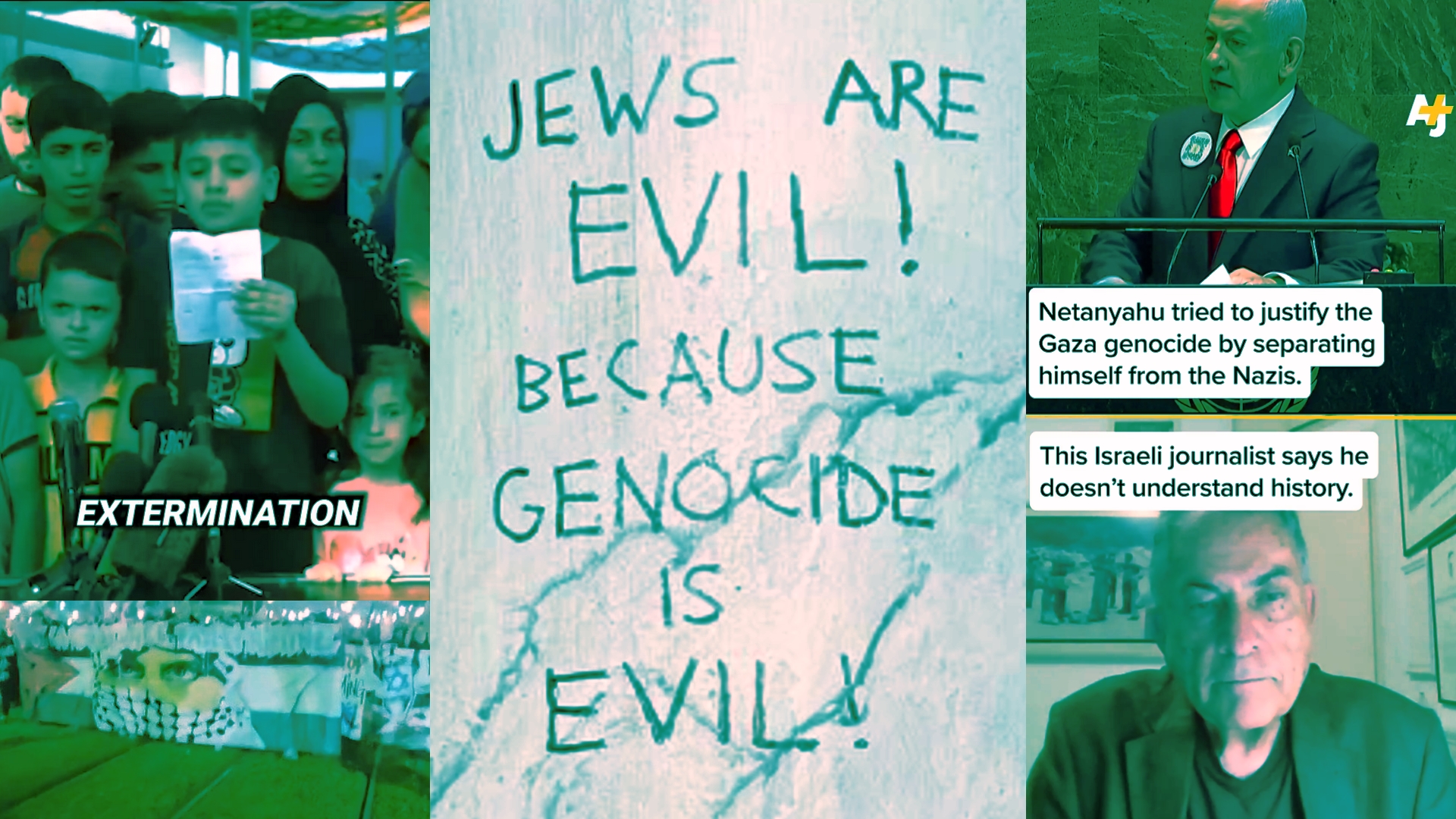
Who does not see the tremendous boon such an imputation represents for antisemites? As Gérard Bensussan masterfully shows in his essay Des sadiques au cœur pur (Sadists of Pure Heart, Hermann, 2025), the defamatory charge of “genocide” prolongs the age-old accusation of ‘deicide’ - the Jews murdering Jesus. We know all too well the endless catalogue of crimes committed under that pretext throughout history. It is impossible to ignore that the demonization of Israel — one of the preferred contemporary forms of antisemitism — is closely correlated with anti-Jewish violence. How can one not grasp that the generalized use of the word genocide against Israel amounts to Nazifying Jews by metonymy while reactivating medieval stereotypes? How can one not see that it permits portraying them as not only hateful beings (the antisemitic activist Sarah Wilkinson, a member of the Global Sumud Flotilla, recently declared that “the Israelis are not human” but “monsters”…) but also that it becomes virtuous to hate them (see Eva Illouz, October 8th: Genealogy of a Virtuous Hatred, Gallimard, 2024)? In early August, an individual wrote the following on the door of Congregation Emanu-El in Victoria, Canada:
“Jews are evil! Because genocide is evil! Stop genocide stop the Jews! Jews are murdering thousands of gentile children In the future Palestinians will get their revenge against you child-killing Jew-monsters!”
The second reason is simply that the use of this term is fallacious. Speaking of genocide is not an objective description mindful of reality. Rather it is a hyperbolic accusation that is part of the corruption of language imposed by this Orwellian era of post-truth, which has rightly worried observers for the past decade. Professor Eva Illouz speaks of a “semantic collapse”, describing a situation where “words no longer mean anything.”
A lie repeated a million times may eventually be believed but remains a lie. The same is true of these lies told ‘for the cause’, uttered in the name of ‘good’, and advanced with even more assurance because no pangs of conscience impede them. Where one might have expected increased vigilance from many avowed opponents of disinformation toward this intellectual blackmail operation orchestrated by a terrorist organization — must we still remind readers? — we have too often observed an abdication of critical thought and indifference to material facts.
Adopting militant slogans out of conformity is not journalism but ideology. When major news outlets capitulate to such a coup, they breach elementary journalistic ethics and the duty of accuracy. By feeding endemic mistrust of the profession and blurring the line that should separate them from spindoctors and propagandists, they ultimately make the job easier for disinformers.
The last reason is that we clearly perceive the psychological and political functions that the accusation of genocide serves, and we refuse to be willing dupes. Observing the behaviour of some participants in the Hamas-encouraged and Ayatollah Khamenei-blessed Gaza flotillas, one can reasonably doubt that everyone who uses the word genocide truly believes it. This indictment has always occupied, as we have seen, a privileged place in the propaganda apparatus aimed at delegitimizing the only Jewish state in the world — a state that no other criminal dictatorship has suffered a quarter of the UN censure it has faced since its creation.
It also frees anti-Israeli activism from self-scrutiny after the atrocities of 7 October 2023 committed by Hamas and its Islamist terrorist allies (PFLP, Islamic Jihad, FDLP, Al-Aqsa Martyrs’ Brigades). The label functions, among other things, as an alibi for Hamas. The terrorist organization, which pursues the creation of a Greater Islamic Palestine “from the River to the Sea,” thus finds an argument to refuse the creation of a demilitarized state: if supporters of the national Palestinian cause convince themselves that Israel is such a mortal enemy, how could Hamas accept laying down arms?
Perhaps the arc of history will be toward a continual stretching of the notion of “genocide,” leading this word — indispensable for understanding the twentieth century — to be irredeemably devalued. Conspiracy Watch will not accompany that movement. We believe it is now part of our professional ethics to resist this dubious injunction.
That said, it goes without saying that we will take into account any new evidence that might warrant revising this judgment. We will not hide behind the argument that only an international court has the legitimacy to use the term genocide. If, hypothetically, it were proven that the State of Israel committed crimes with the intent to “destroy” the Palestinian people “as such” — to borrow the language of the 1948 Convention — we will say so without delay. Conversely, if an international tribunal were to convict a state, any state, for an imaginary genocide, we would join the voices that criticize that decision. In all cases, we will adhere to the line of conduct that has always guided us: to name things correctly.
For sixteen years, Conspiracy Watch has been diligently spreading awareness about the perils of conspiracy theories through real-time monitoring and insightful analyses. To keep our mission alive, we rely on the critical support of our readers.